Garden Structure Glossary
Plain English definitions of the terms you'll come across when researching a covered garden structure. Use the A–Z navigation to jump to any term.
A
Accoya
A premium timber material made from softwood (typically radiata pine) that has been acetylated — a chemical process that makes it exceptionally stable, durable, and resistant to rot. Accoya performs similarly to hardwood oak in outdoor applications but has a more consistent appearance and strong sustainability credentials. It is increasingly used for high-end timber verandas and garden structures.
→ See also: Buyers guide — Timber section
Aluminium (powder-coated)
The dominant frame material for modern UK garden structures. Aluminium profiles are extruded into shape and then powder-coated — a process that applies a durable coloured finish electrostatically and bakes it on. The result is a frame that won't rust, rot, or require repainting, typically guaranteed for 10 years or more. Most systems are available in standard colours (white, anthracite grey, black) with bespoke RAL colours available on request.
→ See also: Buyers guide — Materials section
Awning
A retractable fabric canopy mounted to the wall of a building. An awning extends over a patio or decking area to provide shade and retracts when not in use. Most domestic awnings are motorised and can include wind sensors that trigger automatic retraction. Awnings are a fair-weather solution — they are not suitable for use in heavy rain or strong wind.
→ See also: Buyers guide — Awning section
B
Bioclimatic Pergola
A precision-engineered aluminium pergola with a motorised louvre roof. The louvre blades rotate to open and close, allowing the user to adjust the amount of light, shade, and rain protection. When fully closed, a bioclimatic pergola provides complete rain protection. Most models include integrated LED lighting, infrared heating, and side screen options, making them genuine all-season outdoor rooms. Significantly more expensive than a standard pergola.
→ See also: Buyers guide — Pergola section
C
Canopy
A covered structure providing overhead protection. In the UK market the term is used loosely, but there is a meaningful distinction: a canopy typically refers to a functional, often commercial structure — entrance canopies, walkway canopies, school canopies — whereas a veranda implies a domestic, lifestyle-oriented structure. The two words attract different types of buyer.
→ See also: Veranda, Patio Canopy — Buyers guide — Structure Types section
Carport
A covered structure designed to shelter vehicles. Carports are typically open-sided, supported by posts, with a solid or translucent roof. They protect cars, bikes, and other vehicles from rain, tree sap, bird droppings, and frost. Most residential carports use aluminium frames with polycarbonate roofing.
Conservatory
A glazed room added to a house, typically with a glass or polycarbonate roof and glass walls on three sides. A conservatory is a building work project — it requires building regulations approval and often planning permission, and is built by building contractors rather than specialist outdoor living installers. A glass room is a related but distinct product: lighter in construction, typically not requiring building regulations approval, and installed by specialist canopy or veranda companies.
→ See also: Buyers guide — Glass Room section
D
Decking
A flat outdoor surface, typically constructed from timber boards or composite material, laid at or near ground level adjacent to the house. Decking is a common base for veranda and canopy installations — the structure is built over or alongside it, creating a cohesive outdoor living space. When planning a veranda on existing decking, your installer will need to assess whether the decking structure is sound enough to support post fixings, or whether posts need to be sunk to the ground beneath.
→ See also: Post Feet — Buyers guide — Installation section
E
Eaves Beam
The horizontal beam that runs along the top front edge of a wall-mounted veranda or canopy, connecting the roof to the posts. On quality aluminium systems, the eaves beam is hollow and acts as an integrated gutter — rainwater flows from the roof into the eaves beam and down through the hollow posts, exiting at the post feet. This integrated drainage is one of the key quality indicators for aluminium structures.
→ See also: Buyers guide — Drainage section
F
Fixed Panel (glass room)
A fixed pane of glass used to enclose the sides of a glass room. Fixed panels provide weather protection without the ability to open. Typically used in combination with sliding glass doors — the sliding sections provide access, the fixed panels provide enclosure.
→ See also: Buyers guide — Glass Room section
Freestanding Structure
A garden structure that is not attached to a building wall — supported entirely by its own posts. Freestanding verandas, glass rooms, and pergolas are all available. Freestanding structures tend to cost more than wall-mounted equivalents at the same size, and have slightly different planning implications. They are typically used when the structure is intended to sit in the garden away from the house.
→ See also: Buyers guide — Freestanding section
FSC / PEFC
Certification standards for sustainably sourced timber. FSC (Forest Stewardship Council) and PEFC (Programme for the Endorsement of Forest Certification) both certify that timber has been sourced from responsibly managed forests. When purchasing a timber garden structure, asking for FSC or PEFC certification is the standard way to verify the timber's sustainability credentials.
→ See also: Buyers guide — Timber section
G
Glass Room
A covered outdoor structure with a glass roof and glass or glazed side panels, creating a fully enclosed weather-proof space. A glass room extends from the house wall and feels like an additional room. Unlike a conservatory, glass rooms are typically lightweight structures installed by specialist outdoor living companies rather than building contractors, and generally do not require building regulations approval (though planning permission rules still apply).
→ See also: Buyers guide — Glass Room section
Glass Veranda
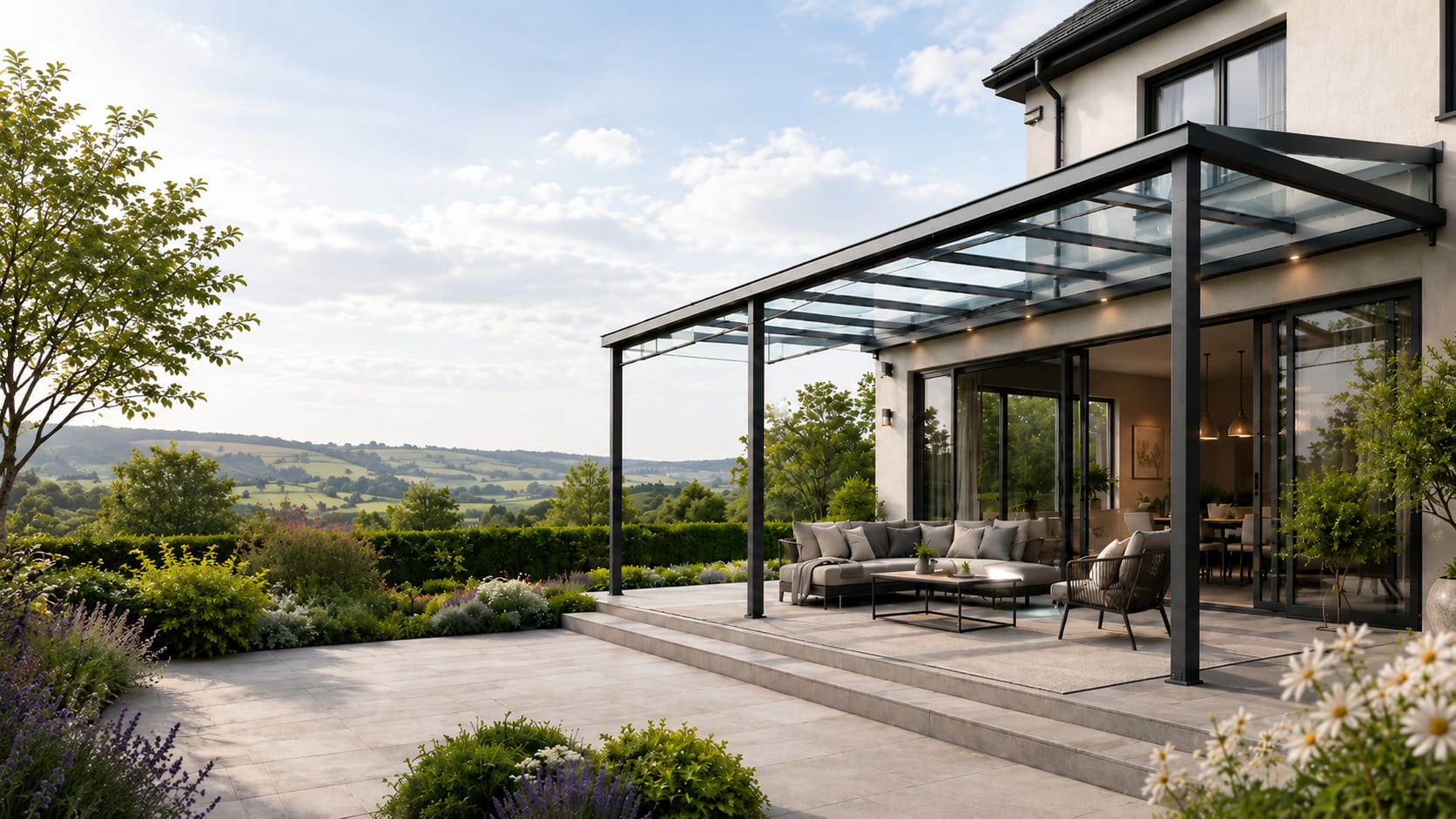
A veranda with a fully glazed roof — toughened or laminated glass rather than polycarbonate. Glass is quieter in rain, doesn't yellow over time, and gives a more architectural appearance. A glass veranda is a step up in quality and cost from a standard polycarbonate veranda. Most glass verandas are aluminium-framed, though bespoke timber versions exist at the premium end.
→ See also: Buyers guide — Glass Veranda section
Goal Post Configuration
A freestanding post arrangement for a canopy or veranda where two posts are positioned at the front of the structure without any wall attachment at the rear. This creates an open, freestanding appearance. Also used to describe a carport configuration where the vehicle passes between two posts rather than pulling up to a wall-mounted structure.
H
Hardwood
Timber from broad-leaved deciduous trees — oak, iroko, sweet chestnut, accoya. Hardwood is denser and more durable than softwood and is used at the premium end of timber garden structures. Oak-framed verandas from specialist joiners are a genuine premium product, often more expensive than mid-range aluminium equivalents. Oak weathers to a silver-grey patina naturally and requires minimal maintenance.
→ See also: Buyers guide — Timber section
I
Infrared Heater
An electric heating element designed for outdoor use, typically mounted to the underside of a veranda or pergola roof. Infrared heaters warm objects and people directly rather than heating the air, making them effective in open or semi-open outdoor spaces. A common upgrade on verandas and glass rooms for year-round usability.
Integrated Drainage
A drainage system built into the structure of an aluminium veranda or canopy, where rainwater flows through the eaves beam and down hollow posts rather than through external PVC guttering. Integrated drainage is a quality indicator — it gives a cleaner finished appearance and is less prone to blockage than tacked-on external guttering. Standard on quality aluminium systems; not available on timber structures.
→ See also: Eaves Beam — Buyers guide — Drainage section
J
Joiner
A specialist craftsperson who designs and builds bespoke timber structures — including oak-framed verandas, garden rooms, and pergolas. A joiner-built veranda is a fundamentally different product and process to an aluminium system installation: it is designed and made to order rather than assembled from manufactured components, and is typically priced accordingly. When sourcing a timber hardwood structure, look for a joiner with specific experience in outdoor structures and ask to see completed examples.
→ See also: Hardwood, Oak Frame
K
Kerb Appeal
The contribution a property improvement makes to the visual impression of a home from the street — or, in the context of garden structures, from the garden itself. A well-chosen veranda or glass room can meaningfully increase the perceived value and desirability of a property. Estate agents increasingly note covered outdoor living structures as a selling point, particularly glass verandas and glass rooms, which photograph well and appeal to buyers who want year-round outdoor space.
→ See also: Buyers guide — Which Is Right for You? section
L
Laminated Glass
A type of safety glass made from two or more layers of glass bonded with an interlayer (typically PVB). If laminated glass breaks, the interlayer holds the shards in place rather than allowing them to fall. Used in some premium veranda and glass room roofs.
→ See also: Toughened Glass
Lean-to
A structural configuration where a roof slopes in a single direction away from a wall. Most wall-mounted verandas and canopies are lean-to designs — the high point is at the house wall, the low point at the front edge. The simplest and most common configuration for domestic garden structures.
→ See also: Buyers guide — Structure Types section
Louvre
A slatted or bladed component used in roofing that allows light and air to pass through at an angle while providing partial shelter. Fixed louvres provide permanent partial shade; motorised louvres (as on bioclimatic pergolas) can be adjusted or fully closed for complete rain protection.
→ See also: Bioclimatic Pergola
M
Multiwall Polycarbonate
A type of polycarbonate roofing sheet with multiple internal walls creating air channels that improve thermal insulation and structural rigidity. Common thicknesses for garden structures are 16mm and 25mm — thicker panels are quieter in rain and better insulated. UV-stabilised versions include a protective coating to reduce yellowing over time.
→ See also: Polycarbonate
O
Oak Frame
A structural frame made from oak timber, traditionally used in barn conversions, extensions, and bespoke garden structures. Oak-framed verandas are built by specialist joiners rather than aluminium system installers and are typically more expensive than equivalent aluminium structures. Oak weathers naturally to a silver-grey without treatment and has a lifespan of 50+ years with proper construction.
→ See also: Hardwood — Buyers guide — Timber section
P
Patio Canopy
An entry-level wall-mounted covered structure for a patio or back door area. Patio canopies typically have slimmer profiles and shorter spans than verandas, and are usually roofed with polycarbonate rather than glass. They can often be installed in a single day and are the most affordable way to get year-round overhead protection.
→ See also: Buyers guide — Patio Canopy section
Pergola
A garden structure consisting of posts and beams with an open or partially covered roof. Traditional pergolas provide partial shade and an architectural focal point but limited weather protection. Modern pergolas may have fixed or motorised louvred roofs. Timber and aluminium are both common frame materials.
→ See also: Bioclimatic Pergola — Buyers guide — Pergola section
Permitted Development
A category of planning permission that is automatically granted by the government for certain types of building work, meaning you do not need to submit a formal planning application. Most domestic verandas, canopies, and glass rooms fall under Permitted Development rights provided they meet specific criteria: single-storey, below maximum height, covering less than 50% of garden, not facing a highway. Permitted Development rights do not apply to listed buildings, conservation areas, or some flats.
→ See also: Buyers guide — Planning permission section
Polycarbonate
A lightweight thermoplastic material widely used for roofing garden structures. Polycarbonate is cheaper than glass, easier to cut and install, and available in clear, opal, and bronze tints. Its drawbacks are that it can yellow or discolour over time with UV exposure, and is noisier in rain than glass. UV-stabilised versions reduce yellowing. For structures over £7,000 in value, upgrading to glass is generally worth considering.
→ See also: Multiwall Polycarbonate, Toughened Glass — Buyers guide — Roof material section
Post Feet
The base fixings that anchor veranda or canopy posts to the ground or paving. On integrated drainage systems, rainwater exits the hollow post through the post feet. Post feet can be surface-mounted (bolted to existing paving) or core-drilled into the ground. The method used depends on the ground conditions and the load requirements of the structure.
Powder Coating
A finishing process used on aluminium garden structures. Powdered pigment is applied electrostatically to the aluminium profile and then baked in an oven, creating a hard, durable, colour-fast surface. Powder coating won't rust, peel, or require repainting. Most systems are available in standard RAL colours with bespoke options available.
→ See also: RAL Colour — Buyers guide — Materials section
Projection
The distance a veranda, canopy, or glass room extends outward from the wall of the house. Projection determines how much covered outdoor space you get. Typical residential projections range from 2 metres to 4 metres, though larger projections are possible on some systems. Deeper projections generally require heavier post profiles and eaves beams to manage the structural load.
→ See also: Buyers guide — Frame quality section
R
RAL Colour
A standardised European colour matching system used to specify powder coating colours for aluminium structures. RAL numbers identify specific colours — RAL 9016 is traffic white, RAL 9005 is jet black, RAL 7016 is anthracite grey (one of the most popular choices for contemporary verandas). Most systems offer a small range of standard RAL colours, with bespoke RAL options available at an additional cost.
→ See also: Powder Coating — Buyers guide — Materials section
Roof Pitch
The angle of slope on a veranda or canopy roof, measured in degrees. Roof pitch affects both the appearance of the structure and its ability to drain rainwater effectively. Most aluminium veranda systems have a minimum pitch requirement — typically 2.5° to 5° — to ensure rainwater drains toward the guttering rather than pooling. The pitch is usually fixed by the system design and cannot be changed by the installer.
→ See also: Buyers guide — Frame quality section
S
Self-Cleaning Glass
A type of glass with a special coating that uses UV light to break down organic dirt and rain to wash it away. Self-cleaning glass is a premium upgrade for veranda and glass room roofs — it significantly reduces the frequency of manual cleaning, which is particularly valuable for roof glass that is difficult to access.
→ See also: Toughened Glass — Buyers guide — Roof material section
Sliding Door (glass room)
A glazed door panel that slides horizontally on a track, used to provide access to an enclosed glass room or veranda. Sliding glass doors allow the space to be opened up in good weather and closed against wind and rain. Available in various configurations — single, double, or multi-panel.
→ See also: Glass Room, Fixed Panel — Buyers guide — Glass Room section
Snow Load
The structural load imposed on a roof by accumulated snow. In the UK, snow load is a relevant design consideration for veranda and canopy roofs, particularly in northern England and Scotland. Reputable aluminium system manufacturers test and certify their systems to specific snow load ratings. When comparing systems, ask for the snow load rating (measured in kN/m²) and check it is appropriate for your location.
→ See also: Buyers guide — Warranty section
Softwood
Timber from coniferous trees — most commonly pressure-treated pine or spruce. Softwood is the most affordable timber option for garden structures and looks attractive when new, but requires annual treatment with preservative or stain to prevent decay. Over a 10–15 year lifespan, the cumulative maintenance cost closes the gap with aluminium considerably.
→ See also: Hardwood — Buyers guide — Timber section
T
Toughened Glass
Safety glass that has been thermally treated to increase its strength. Toughened glass is approximately four times stronger than standard glass and, when broken, shatters into small rounded fragments rather than sharp shards. It is the standard glazing specification for veranda and glass room roofs. Also referred to as tempered glass.
→ See also: Laminated Glass, Self-Cleaning Glass — Buyers guide — Roof material section
U
uPVC
Unplasticised polyvinyl chloride — a rigid plastic used for window frames, fascias, and some entry-level garden structures. uPVC structures are cheap to produce and don't require painting, but are less structurally capable than aluminium at equivalent profile sizes, and can discolour, warp, or become brittle over time. Most specialist outdoor living installers do not offer uPVC structures. If comparing quotes, confirm the frame material — a uPVC quote and an aluminium quote at similar prices are not comparable products.
→ See also: Buyers guide — Materials section
V
Veranda
A covered structure attached to a house wall, projecting outward over a patio or outdoor area. Verandas are typically heavier-duty than patio canopies, with wider post profiles and the option of glass or polycarbonate roofing. Available in aluminium, timber (softwood and hardwood), and occasionally uPVC. A veranda creates a defined outdoor room rather than simply a covered area. In UK search behaviour, 'veranda' carries domestic intent — it implies a lifestyle-oriented addition to the home.
→ See also: Canopy, Glass Veranda, Glass Room — Buyers guide — Veranda section
W
Wall Plate
A fixing bracket or plate used to attach a wall-mounted veranda or canopy to the house wall. The wall plate transfers the structural load of the roof back into the wall. Installation of the wall plate requires drilling into the masonry and using appropriate fixings for the wall construction type (brick, block, render, or timber frame). A good installer will assess the wall construction before specifying the fixing method.
Wind Load
The structural load imposed on a structure by wind pressure. Alongside snow load, wind load is a key structural consideration for verandas and canopies — particularly for larger projections and exposed locations. Reputable systems are tested and certified to BS EN standards for wind load resistance. Ask for the wind load rating (measured in kN/m²) when comparing systems, and flag any unusually exposed or coastal locations to your installer.
→ See also: Buyers guide — Warranty section
X
Cross-Laminated Timber (CLT)
An engineered timber panel made by layering and gluing softwood boards at right angles to each other, creating a strong, dimensionally stable structural material. CLT is used in contemporary architecture and occasionally in premium bespoke garden structures and garden rooms. It offers the warmth and sustainability credentials of timber with greater structural predictability than solid sawn timber. A niche choice for garden structures currently, but growing in use as the outdoor living market moves upmarket.
→ See also: Hardwood, Softwood
Y
Year-Round Use
The ability to use a covered garden structure comfortably throughout all four seasons — including autumn and winter. Not all structures achieve this. An awning is fundamentally a fair-weather product. A standard pergola provides shade but not rain protection. To genuinely extend outdoor living into the colder months, you need a structure with a solid weatherproof roof (polycarbonate or glass veranda, glass room, or closed bioclimatic pergola) and ideally an infrared heating upgrade. A structure described as suitable for year-round use should be tested against a wet November afternoon, not just a sunny July evening.
→ See also: Buyers guide — How much weather protection do you actually need? section
Z
Zzz (Under Your Perfect Canopy)
The sound of rain on a polycarbonate roof at 6am, heard from a dry garden chair with a cup of coffee. The smell of a damp garden through an open glass room on an October morning. The particular satisfaction of eating outside in September when everyone else has gone in.
If that's what you're after — you're in the right place.
→ Start here: A UK Buyer's Guide to Choosing the Right Garden Structure